Nestled among the rolling hills of the Australian Capital Territory, Canberra is a city that began as a compromise and became a statement — a meticulously planned capital whose geometry still speaks to the vision of a single architect more than a century on.
The Griffin Vision
In 1911, American landscape architect Walter Burley Griffin won an international competition to design Australia's new federal capital. His bold plan centred on a series of geometric axes radiating from Capitol Hill, with a grand artificial lake at the city's heart reflecting the sky and the mountains beyond. Construction was slow — wars, funding disputes, and political wrangling all delayed progress — but the essential shape of Griffin's dream survived intact.
Today, standing on Mount Ainslie and looking south-west, you can see that plan made real: ANZAC Parade arrows toward Old Parliament House and the new Parliament House on Capitol Hill, with Lake Burley Griffin shimmering in between. It is one of the most deliberate urban vistas on earth.
A City of Milestones
By the Numbers
The Lake & the Land
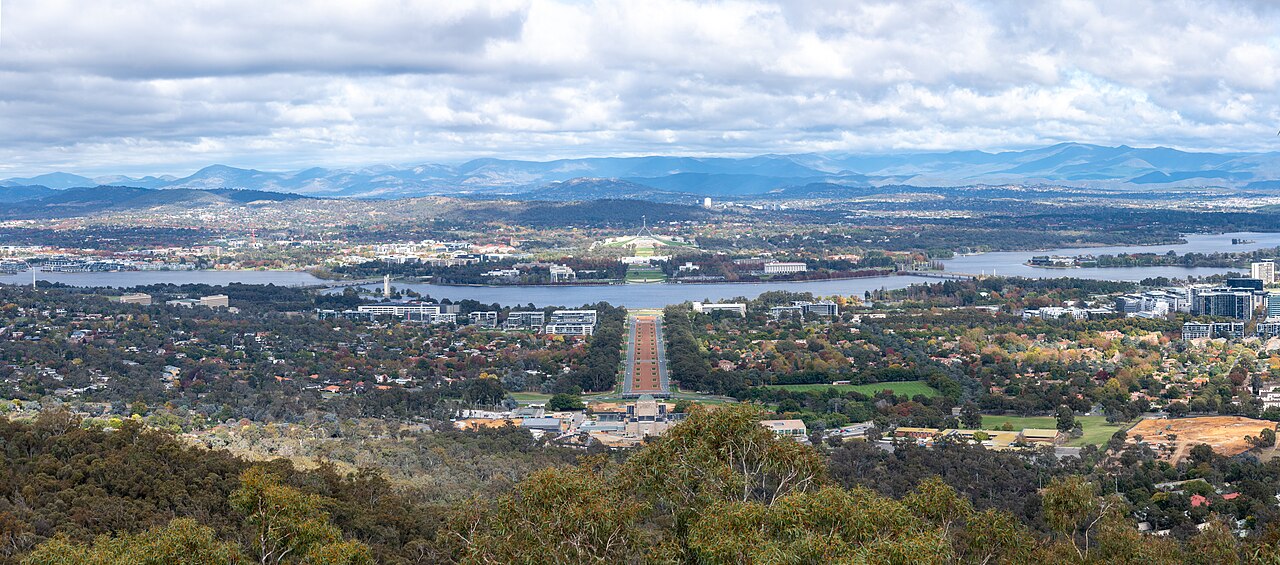
Lake Burley Griffin was a centrepiece of Griffin's original plan but took decades to become reality. The Molonglo River was dammed in 1963 and the 35-kilometre shoreline quickly became the social spine of the city. Today it hosts the National Carillon, the Captain Cook Memorial Water Jet, and the elegant Reconciliation Place, while the lakeside precincts of Parkes and Acton hold the National Gallery, National Museum, and Australian National University.
Culture & Institutions
Canberra punches well above its weight as a cultural destination. The National Gallery of Australia holds the nation's finest art collection, anchored by the Sidney Nolan Ned Kelly series and an international collection of surprising depth. The Australian War Memorial draws close to a million visitors a year — its domed Hall of Memory and the eternal flame in Commemorative Courtyard among the most moving spaces in the country.
The National Library, the National Archives, the Museum of Australian Democracy in Old Parliament House, and Questacon's science centre complete a cultural precinct that is unique in the southern hemisphere. There is more to see here, per square kilometre, than almost anywhere else in Australia.
Getting There
Canberra Airport has direct flights from Sydney (50 min), Melbourne (75 min), Brisbane, and other capitals. By road, it is roughly three hours south of Sydney via the Hume Highway. The city is compact enough to navigate easily — a hire car or rideshare is the most practical way to get between the scattered national institutions, though the town centre and the lakeside strip are pleasant on foot.